2026 Laing Lectures
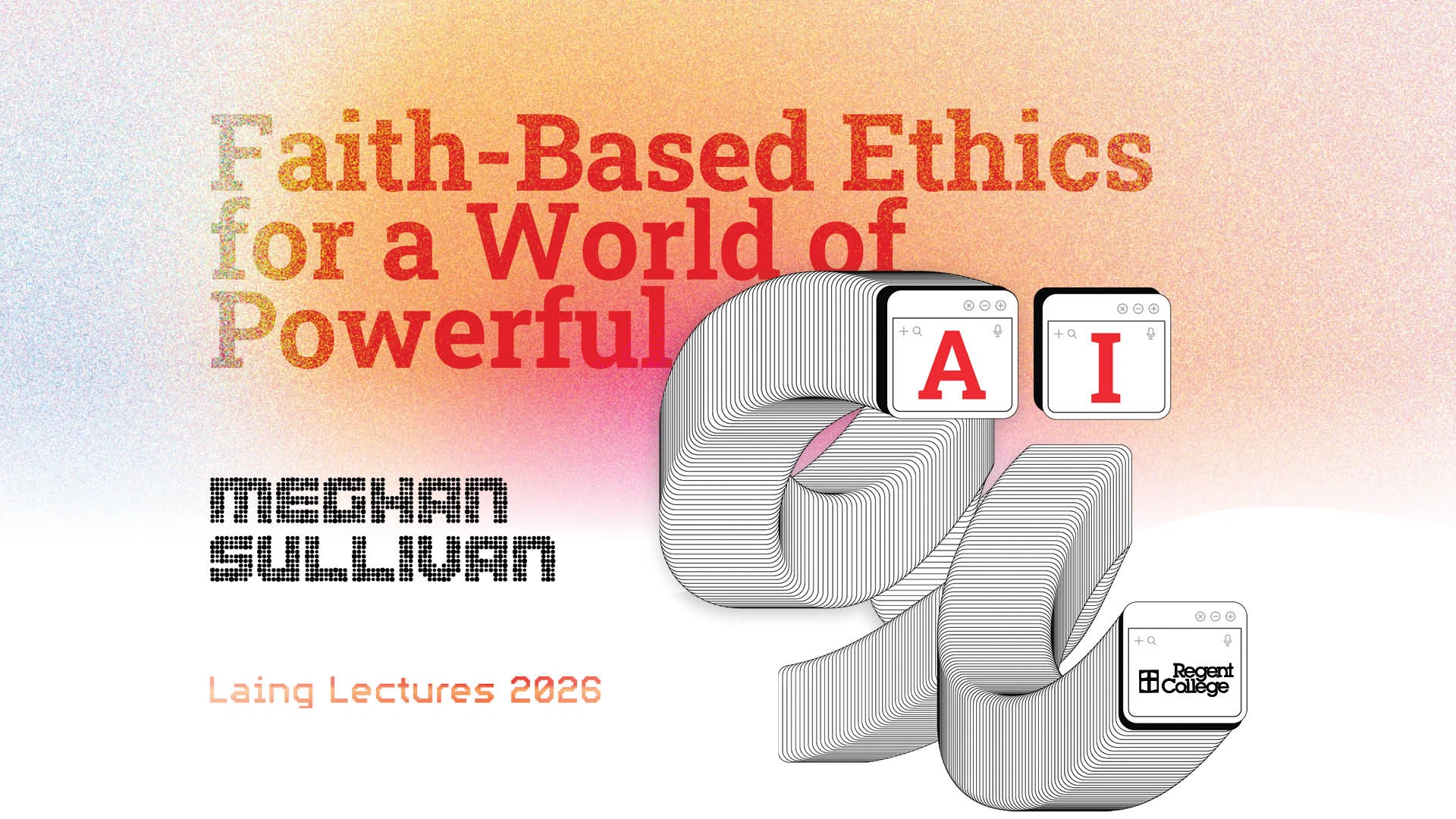

Faith-Based Ethics for a World of Powerful AI
On March 23 and 24, join us in the Regent College Chapel or online for an exploration of faith, ethics, and the technological trajectories shaping our world.
Regent College is pleased to welcome philosopher Meghan Sullivan to this year’s Laing Lectures. Highly regarded for her philosophical explorations of time, happiness, faith, and meaning, Dr. Sullivan gives direction to scholarly initiatives centred on ethics and the common good.
In her first lecture, Dr. Sullivan will discuss the vital role of the Christian ethical imagination as the focus of the global economy shifts from digital search and advertisement to large models and agentic AI. Drawing on consultations with diverse Christian leaders, she’ll highlight five concepts from the Christian ethical tradition and their relevance to current debates around the development and deployment of powerful AI.
In her second lecture, Dr. Sullivan will narrow her focus to Christian teaching about the dignity of work. Developed in the shadow of the Industrial Revolution, this philosophical and theological project cries out for updating and renewal as AI rewrites global economies and social contracts. Finally, she’ll help us apply these theories to some concrete questions by looking at how the Christian ethical tradition can inform our use of AI in schools and workplaces.
Lectures
The DELTA Framework—Where Is the Christian Voice in AI Ethics?
Monday, March 23・7:30–9 pm・Livestream
Faith communities played a central role in major twentieth century debates in applied ethics, especially surrounding nuclear armament, civil rights, and bioethics. But for a variety of reasons, these same groups were sidelined for the ethical debates at the dawn of the digital era. As we now make the transition from a search-advertisement digital economy to one based on powerful large models and agentic AI, it is more important than ever that we expand our ethical imagination. Based on over one hundred interviews with Catholic, evangelical, and mainline Protestant leaders (conducted through a recent planning grant with the Lilly Endowment), this session will discuss five concepts from the Christian ethical tradition and their relevance for debates about developing and deploying powerful AI. It will also consider the relevance of philosophical and theological thinking about AI given current economic and political conditions around the industry.
The Dignity of Work and the Dignity of Learning
Tuesday, March 24・7:30–9 pm・Livestream
Modern Christian social thought began in the 1800s with reflections on industrialization and its effects on workers and families. This teaching on the dignity of work is sorely in need of an update as AI completely rewrites our economy and social contract. In this session, we’ll zero in on Christian teaching about the dignity of work and how this teaching applies now to a technology that fundamentally affects our learning and thinking. We’ll consider what philosophy and theology has to offer us in understanding the role of learning in human dignity, and how this teaching should shape how we roll AI out in our schools and offices.
Lunchtime Q&A
Wednesday, March 25 • 12:15–1 pm • Onsite Only (Room 100)
Speaker
Meghan Sullivan
.jpg)
Dr. Meghan Sullivan is the Wilsey Family College Professor of Philosophy at the University of Notre Dame. She serves as Director of the University-wide Ethics Initiative and is the founding director of Notre Dame’s Institute for Ethics and the Common Good. The university hub for research and teaching in ethics, the Institute includes the new Rev. John I. Jenkins, C.S.C, Center for Virtue Ethics and the Notre Dame–IBM Technology Ethics Lab. The Institute is home to faculty program chairs, postdoctoral fellows, PhD students, and undergraduates and runs several residential fellowship programs for faculty, nonprofit leaders, and faith leaders.
Dr. Sullivan is deeply interested in the ways philosophy contributes to the good life and the best methods for promoting philosophical thought. She has served as principal investigator for over $15 million in grants to advance ethics and human flourishing, from agencies including the John Templeton Foundation, the Lilly Endowment, the Mellon Foundation, and the National Endowment for the Humanities. Time Biases, her 2018 book with Oxford University Press, offers philosophical guidance about how to navigate the puzzles that the passage of time poses to rational planning. It was featured in a 2021 New Yorker piece. In 2022, Dr. Sullivan published The Good Life Method with Penguin Press (co-authored with her teaching collaborator Paul Blaschko) based on a wildly popular introductory philosophy course she developed at Notre Dame called “God and the Good Life.” Since 2016, “God and the Good Life” has accompanied thousands of Notre Dame students through the process of developing a philosophical plan for their lives. In the past, Dr. Sullivan has collaborated with faculty in other departments to offer courses on NBC’s The Good Place, Ted Chiang’s science fiction, and Thom Browne’s fashion empire.
Dr. Sullivan is currently working on a book about the role of love in our moral lives. She is also directing a major grant project with scholars and nonprofit leaders to expand the love ethic, as well as a major planning grant considering the role of Christian thought in AI ethics.
Dr. Sullivan has been honored with one of Notre Dame’s Joyce Awards for Teaching, with the Provost’s All-Faculty Team Award, and with the City of South Bend’s 40 Under 40 Award. She holds degrees from the University of Virginia (BA: Philosophy and Politics, Highest Distinction), Oxford (BPhil: Philosophy), and Rutgers (PhD: Philosophy), and has studied at Oxford as a Rhodes Scholar (Balliol College).
Dr. Sullivan enjoys cooking, building elaborate Lego sets, reading science fiction, and traveling the world. She cheers for the Fighting Irish and Virginia Cavaliers in all of their endeavors, and when they play each other she has a rational crisis.
About the Laing Lectures
The Laing Lectures began at Regent College in 1999 in cooperation with Roger and Carol Laing and in honour of their father, William John Laing. The purpose of the lectures is to encourage persons recognized for scholarship, wisdom, and creativity to undertake serious thought and original writing on an issue of significance for the Christian church and to promote the sharing of such thoughts through a series of public lectures.
The material presented by Laing Lecturers is intended to move beyond an analysis of historic and current concerns to provide proposals for alternative action for the Christian church. In doing so, lecturers are invited to explore in an interdisciplinary way the relationship between Christianity and culture, and to suggest ways in which that relationship might lead to greater flourishing of the church, the larger human household, and the whole community of creation.
The following speakers have delivered Laing Lectures: Neil Postman (2000), Charles Taylor (2001), Peter Berger (2002), Margaret Visser (2004), Miroslav Volf (2006), Nicholas Wolterstorff (2007), Walter Brueggemann (2008), Susan Wise Bauer (2010), Albert Borgmann (2011), Rex Murphy (2012), Ellen T. Charry (Spring 2014), Ross Douthat (Fall 2014), Iain McGilchrist (2016), Marilynne Robinson (2017), Stanley Hauerwas (2018), Malcolm Guite (2019), John Milbank (2022), Curt Thompson (2023), George Yancey (2024), and Janet Martin Soskice (2025).
